Acushnet
The WhaleThe Acushnet was a newly built Fairhaven whaling ship that carried Herman Melville toward the Pacific in 1841, and its importance lies in the contrast between its imposing industrial purpose and the precarious lives of the people aboard. A crew list dated 30 December 1840 records Melville among twenty-six men preparing to sail under Captain Valentine Pease. The ship was not merely a setting for a literary voyage: its dimensions, ownership, profit shares, and contracts expose the organized economy that turned a ship and its crew toward the harvest of whales.
Construction and purpose
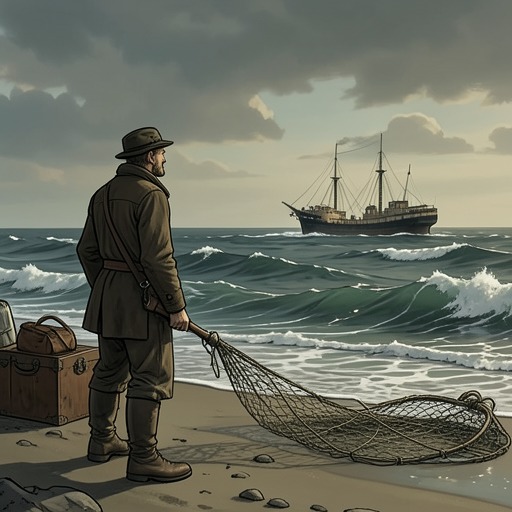
At 104 feet long, 27 feet wide, and 13 feet deep, the Acushnet towered over the wharf at Fairhaven. Named after the river on which it was launched, it had a full hull and long spars, an appearance that joined industrial scale to the image of a vessel built to endure. The ship had recently come off the production line during a boom when new whaling vessels were being built rapidly. Some ships had previously carried passengers; the Acushnet belonged to a trade that repurposed maritime capacity for the long pursuit of whales.
Its practical character distinguished it from the more theatrical Pequod of Melville’s fiction. The Acushnet lacked whale-tooth ornament and a tiller made from a whale’s jaw. Instead, its side bore false gunports, a disguise intended to discourage attack by pirates or people described in the account as savages. That detail gives the vessel two faces: a working ship designed for extraction, and a ship that presented a defensive image to the dangers imagined beyond the wharf. Its name connected it to the river and port from which it sailed; its painted features advertised a protection it could not guarantee.
Crew, shares, and command
The Acushnet was owned by a syndicate of eighteen men, including the Quaker agents Melvin O. Bradford and Marlboro Bradford. Its captain, Valentine Pease Junior, was forty-three and had already commanded the Houqua. The account of that earlier voyage describes a troubled record: a first mate was discharged in Tahiti under circumstances left unclear; seven men drowned, two more died after a boat was stove in by a whale, and eleven crew members deserted. Only three of the original company returned to claim their shares. This history places the Acushnet within a dangerous trade in which command, weather, whales, and desertion could determine who came home.
The crew’s expected earnings were divided into fractional lays rather than equal wages. Pease, as master and part owner, was entitled to one-twelfth of the profits; first officer Frederic Raymond of Nantucket, one twenty-fifth. Melville, signed as a foremost hand, received one seventy-fifth, while the greenhand Carlos Green of New York was allotted one one-hundred-and-ninetieth. The fractions made rank and experience legible in money: the ship’s future profits were apportioned across a hierarchy before the voyage began. For the cook William Maiden and deckhands Thomas Johnson and Enoch Read, whose complexions were recorded as black or mulatto, even a small share could offer an opportunity within a society where they had previously laboured under a master.
The agreement also bound crew members to remain aboard until the hold was full of oil and subjected them to rules governing conduct and discipline. Clothing bought from the ship’s own supplies could be charged against a sailor’s share, so expenses might consume the expected earnings and leave a man with nothing, or in debt. The conditions help explain why the voyage’s labor arrangement could feel less like freely chosen adventure than an obligation with few safe exits. Two men deserted before the Acushnet even sailed; in all, only eleven of the original twenty-six were expected to return. The contract’s authority did not prevent desertion; the scale of departure instead registers the pressure of the life it imposed.
A vessel within a wider world
The Acushnet left from Fairhaven, across the river from New Bedford, at a moment when the linked port communities were enriched by whaling. Their success rested on a sheltered harbour, connections across New England, and ties to Quakers of Nantucket who had helped develop the fishery. The ship’s voyage therefore began within a local economy whose reach extended across the ocean. Its crew list and profit shares translate that global enterprise into individual names, ranks, and fractions.
The wider whaling world was also made by people from many backgrounds. In New Bedford, Frederick Douglass had lived and worked after escaping slavery, taking on varied manual jobs for four years. The account compares the shipyard to a schoolhouse for Douglass and other Black workers, while describing the whaling workforce as including Africans, Indigenous people, Azoreans, and Cape Verdeans, alongside Americans born in the country. In the town, distinct immigrant neighbourhoods and multiple languages reflected that diversity. Such context sharpens the meaning of the Acushnet’s crew records: the ship belonged to an industry whose labor was drawn from a broad, unequal society, not simply from the familiar image of the white New England sailor.
Literary and social significance
Melville’s later fiction transformed the whaling ship into a contained world, and the Acushnet voyage supplies a biographical counterpart to that imaginative form. Ishmael describes a whale ship as an education; the real voyage makes that claim concrete in a different register, through the crew’s shared exposure to a long journey, strict hierarchy, and uncertain returns. More generally, the whaling ship was a bounded community at sea, governed by officers and organized around the work of pursuing and processing whales. This does not make the Acushnet interchangeable with every shipboard episode in Melville’s fiction. Rather, its documented crew and material conditions help explain the social pressures that made the ship a powerful subject for him.
The Acushnet thus stands at the meeting point of literary memory and industrial history. Its impressive scale represented a flourishing trade, while its fractional shares, costly onboard supplies, departures, and unequal labor reveal what that prosperity demanded from the people aboard. The ship carried Melville toward the Pacific, but its significance extends beyond his passage: it makes visible the system of ownership and work behind whaling, and the human instability concealed within the clean arithmetic of a crew list.